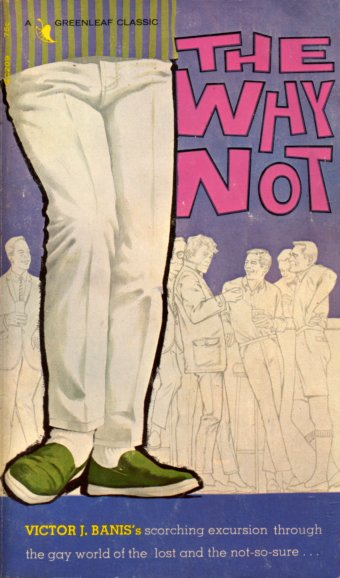


Who was Lady Agatha? They were first introduced in the pulp classic, The Why Not. According to Victor, they even came up with the name:
“The Why Not was modeled after an actual bar, The Castaways, on Commonwealth Avenue, and in its heyday, it was perhaps the most popular gay bar in Hollywood. Incidentally, it was my old friend, Elbert Barrow (who was the model for Lady Agatha in the book) who nicknamed it the Why Not. A typical Saturday afternoon exchange might go, “Are you coming to the bar tonight?” and the answer was usually, “Why not?”” – forward to 2nd ed. Of The Why Not, Borgo Press
Lady Agatha was a central character in the 8th book of the C.A.M.P. series The Gay Dogs (see excerpt below). They were also a character in the 10th book, Gay Safe (presumably written by Sam Dodson).
They later became writing partners with Victor. They co-wrote The C.A.M.P. Guide to Astrology in 1968 and The C.A.M.P. Cookbook in 1969. Through these books one gets a glimpse of Lady Agatha, the character. I was surprised to learn that they are also credited with co-writing Gay Treason byline, J.X. Williams, in 1968.
As Victor mentions above, Lady Agatha was Elbert Barrow. He was a close friend of Victor and Sam Dodson, later serving as their secretary. Unfortunately, I don’t know much more. A simple internet search yielded nothing. As Victor mentions below, he “wrote columns for the local gay sheets.” I supposed I could do a deeper dive into those “sheets”. I know that The ONE National Gay & Lesbian Archives at the USC Libraries has a large collection of these things.


I believe he wrote the book Hollywood…Gay Capital of the World (1968). I do not know for sure but the author is L. Jay Barrow and “Don Holliday” aka Victor, wrote the forward. I have not read this book yet – though I plan to. I do not have a digital copy, only the original, tangible form and, if anyone reads these blogs, they will know I’m always afraid of breaking the spines of these old pulp books.

I have a suspicion that Elbert was a character in The Flaming Suckers byline Jay Symon (1969). This is only a theory. The main characters are: Dodd = Sam Dodson; Gil = Victor (short in height, blonde hair); Alvin = Elbert? Victor often referred to him as Al. It is the only book I could find by “Jay Symon”. Maybe they all wrote it together? Maybe I’m reading too much into it.
But I don’t know anything more than what I suspect and what Victor wrote about him. You get a glimpse of the character, Lady Agatha, but not really the person, Elbert Barrow. Victor mentions Lady Agatha a couple times in his memoir, Spine Intact, Some Creases.
“Lady Agatha, originally introduced in The Why Not and later a recurring character in the C.A.M.P. books, was based on my friend, Elbert Barrow. Delighted with his character as presented in the books, Elbert adopted the name as his own, and with the success of those books, Lady Agatha became a popular fixture on the Los Angeles gay scene of the late sixties and early seventies. He was my secretary for years and penned the C.A.M.P. cookbook and the astrology guide and wrote columns for the local gay sheets. Incidentally, in a plumber’s costume, with a dark bobbed wig, which became his standard drag, he was a double for Josephine the Plumber, the Jane Withers character then popular in television commercials.” Spine Intact, Some Creases

The only thing I have been able to find regarding Elbert the person comes later in Victor’s memoir where I discovered his death, though I don’t know what year. 1979?
“I had lost my dear friend and colleague, Lady Agatha – Elbert Barrow. Out of the blue, in 1977, Elbert took sick. He developed a rare kind of pneumonia as a result of ‘mysterious allergies’, as the doctors saw it. He began to waste away and ugly lesions, a rare form of skin cancer, began to appear on his arms and legs – sound familiar?
For the next two years we went from hospital to hospital, with little success. The doctors would release him, I would take him home, and within a few days he would call me, barely able to breathe, and off we would go to yet another hospital. His weight dropped from a hearty 160 pounds to 90. In appearance he went from forty years old to eighty, his hair, what was left of it, from dark brunette to snow white. He was confined to a wheelchair and kept a tank of oxygen with him at all times.
It was a grueling couple of years and heartbreaking to watch this old friend waste away. It was not until he had gone and I began to read newspaper accounts of a mysterious ‘gay cancer’ that I realized the truth: El had died of aids before it was aids. He was, as it turns out, one of the first of what my friend Luis Cordero has dubbed ‘the missing generation.’” Spine Intact, Some Creases, pg 224
These three paragraphs make me sad. When Victor wrote his memoir he was at a turning point in his life. There was a revival of gay pulp fiction and his works. He lost his job at Casa Sanchez. He was leaving his beloved San Francisco because it was too expensive and moving to West Virginia with a 3 or 4 month pit-stop in his hometown of Eaton, Ohio. I know this was an emotional, reflecting time for him. I’m sure it was difficult for him to relive this painful memory!
This is about all I know – which begs so many questions. Did Elbert have family that accepted him? Did he have a mother and/or niece that cared about him? Where was he from? What happened to his body after he died? I couldn’t find anything on findagrave.com. Was he cremated? What happened to his ashes? His passing happened so early in the AIDS crisis and so little was known about the disease. Were people afraid to touch him? See him? What was it like going to the hospitals? Was there a celebration of life for him?
Why is he not more remembered and celebrated?
I will continue to search for Elbert. He was a central figure in the 1960s Hollywood gay scene and an early player in gay liberation. He deserves to be remembered. If anyone has any more information on this intriguing person, please let me know!
Here is an excerpt from Gay Dogs (1967)
It had started as a dull night for Jackie. The slender blond had found himself with a free evening – nothing and no one to do. The Westgate, a quiet-seeming little beer bar he sometimes visited, had seemed like a likely place to correct the situation. To his disappointment, however, the place had offered rather scant prospects.
He had been on the verge of finishing his beer and leaving when the redhead had entered and taken a seat next to him. The way things were progressing, it looked as though he soon have something to do after all.
It was just at that moment that Lady Agatha entered the bar, pausing inside the swinging door to adjust his eyes to the dim light. Jackie knew, as soon as he saw his gay friend, that his hopes for whisking his new playmate quickly away were in vain.
Lady Agatha was a close friend, of many years standing and one whose company Jackie ordinarily enjoyed immensely, but he was not the sort of friend with whom one exchanged a fast hello and good- bye.
Lady Agatha liked to talk – his supply of gossip, anecdotes, news, and just plain trivia, was virtually endless, and always eagerly shared.
Having become accustomed to the lighting, Lady Agatha looked slowly around him. His eyes widened still more when he saw Jackie – and even more when they rested on the attractive young man seated beside Jackie. Lady Agatha was a true connoisseur of masculine beauty.
Jackie knew as he watched the smiling brunette cross the room, that he was in for competition.
“Hello, sweets,” Agatha greeted him; his glance quickly and meaningfully moved on to Jackie’s companion. “And what have we here? Someone I haven’t met yet.”
“To be honest, I haven’t officially met him either,” Jackie answered, realizing he still didn’t know his new friend’s name. He turned also to the redhead.
“I’m Don Daniels.” Jackie’s hand was clasped in a firm grip.
“Jackie Holmes. And this is my old friend, Al Barlow.”
“Better known as Lady Agatha – and be careful about using words such as old.” Lady Agatha shook hands with Don, her eyes making much the same trip Jackie’s had made before, with a few side visits.
“How did you ever get a name such as Lady Agatha?” Don asked. “You don’t look like a Lady Agatha to me.”
“It’s a long story,” Jackie answered before Lady Agatha could start with an explanation. He knew from past experience that once Agatha got the conversational ball rolling he would hang on to it until he had made a basket, and this time Jackie had his heart set on being the one who got the basket. “It had to do with a bar we used to frequent – some evening when we have lots of time, I’ll tell you all about it.”
“There’s nothing wrong with the present,” Agatha countered. “Unless someone’s in a hurry.”
Jackie suppressed a sigh of disappointment. His spirits lifted however as he looked up and his eyes met Don’s. Unless he was a poor judge, Don was just as impatient to be going as he was.
“Well, as a matter of fact, we were just planning to finish our beers and leave,” Jackie answered.
The conversation was interrupted temporarily by the arrival of the bartender, carrying two glasses of beer. “From an admirer,” he explained, setting one in front of Don. “And one for you, from the same admirer,” he finished, handing the other one to Lady Agatha.
“Who’s our admiring friend?” Don asked.
“The fellow at the other end of the bar.” The bartender explained, nodding toward the end where a single fellow sat by himself. Both Don and Agatha smiled in the direction of their benefactor and lifted their glasses in silent thanks.
“Heavens, men literally throwing themselves at my feet,” Agatha exclaimed. “I suppose I should go down there and let him bask in my charm for a few moments.”
“If you do that,” Don answered, “I still won’t get to hear your story, and as long as we have to stay to finish these beers, you might as well tell me all about that.”
Jackie felt suddenly left out of the scene – it was not only a question of vanity – after all, there had been plenty of men to send him drinks before, and would be again. At the same time it was puzzling that the stranger would have signaled out Agatha and Don for his attention and ignored a third person with them. Unless, of course, he was interested in getting a three-way started; that wasn’t as unusual as many people thought, particularly in a bar of this sort.
The really disappointing fact, however, was that Don’s attention was now suddenly all centered on Agatha and her story. A moment before Jackie had been sure Don’s interest was in him; now Don had eyes only for Agatha. Neither one of them, in fact, seemed to notice that Jackie was without a drink.
Silently, Jackie signaled the bartender to bring him another beer also, and turned to listen politely to Agatha’s familiar narrative. It was, as usual with Agatha, an entertaining bit of conversation. Despite his disappointment, Jackie found himself sharing Don’s laughter. It was impossible to remain annoyed with Agatha for more than a few moments.
By the time they had nearly finished their beers Jackie was once again in good spirits. Now that the conversational scene was ending, he was confident he and Don would be leaving together.
“Heavens, I’ve been talking so much I scarcely knew I’d finished my beer,” Agatha declared. He glanced from one to the other, and then remembering his manners, gave Jackie’s leg a pat. “But I know you too were anxious to be on your way. I’ll let you make your escape now.”
“Don’t be silly,” Don objected. “I’m having a great time.”
Taking no notice of Jackie’s surprise and consternation, Don signaled the bartender for three more beers. Glumly, Jackie resigned himself to further delays. It was beginning to look like Agatha would be winning the prize after all, without even really trying.
The conversation continued through the next beer, with Agatha as usual doing most of the talking, and Don an enthusiastic audience. Jackie kept up an appearance of interest, even though his heart wasn’t really in it. He glanced once around the bar, wondering if there was anything else present that he should be working on, just in case.
He saw the stranger who had sent the beers to Agatha and Don – not bad, Jackie decided, studying the man briefly. A little too beefy and husky for Jackie’s taste – not exactly the type one would want to meet in a dark alley – and not the type, Jackie found himself thinking, to be sending drinks to strangers in bars.
Now that’s, just sour grapes, he told himself angrily. It was nothing short of childish to resent the fact that his two companions had been singled out for some flattery.
The stranger got up and made his way toward the door out of the bar. He caught Agatha’s eye as he went, and called a friendly, “Good night.”
“Oh, you’re not leaving?” Agatha interrupted herself. “Won’t you join us and let us repay the beer?”
“Afraid not,” the stranger answered. “I’ve got an engagement already.” He gave Don a wave also, and disappeared through the door.
“Peculiar one,” Agatha decided, staring after him. “I was sure he was positively smitten by me – or by the both of us, I should say.
“Maybe he decided you were inseparable,” Jackie commented.
“I guess we’d better be going,” Don declared, finishing off the last of the beer. It was an abrupt change of interest that caught Jackie off guard.
“Fine,” Jackie agreed with genuine enthusiasm.
“Oh, no you don’t,” Agatha said firmly. “Not until I’ve bought a round. After that, I’ll let you to yourselves.” He placed some money on the bar. “Be a dear and get them for me, Jackie. I have to go out to the car and check on Cynthia.”
“Cynthia?” Don asked, puzzled.
“A Yorkshire terrier,” Jackie explained. “But you don’t mean to tell me he’s been outside all this time?”
“Oh, pooh” Agatha dismissed the note of concern with a wave of his hand. “She hasn’t been suffering, I can assure you. Once she’s eaten, she sleeps like a dead person. She probably doesn’t even know I’m not in the car with her – and anyway the doors are all locked, so no one’s going to spirit her away.”
Agatha headed out of the bar, while Jackie shrugged and gave Don a weak smile. “I guess we’ll have to have one more,” he said. “But we can drink them fast.”
“Fine.”
Curious, Jackie found himself thinking, a very puzzling young man. Even though it was Don who had finally suggested they leave, Jackie could not quite get over the feeling that the redhead really did not much care whether they went together or not. Jackie dismissed the thought, however, and ordered the drinks.
Agatha was back in a moment, and it was obvious from the instant that he burst through the door that something was wrong. There was alarm written all over his face, and as he rushed across the small room toward Jackie, there were tears in his eyes. “Jackie, something awful’s happened,” he exclaimed. “They’ve taken my baby – Cynthia!”
“Cynthia?” Jackie jumped to his feet. “Who’s taken her?”
“I don’t know,” Agatha wailed, fairly beside himself. “She’s been stolen – oh, come see, please.”
Jackie was out of the door before Agatha. He looked down the darkened side street and recognized Agatha’s car at once, a small economy model. Even before he reached the car, he could see the smashed windows and. the brick lying nearby that had been used to smash them. Someone had wanted inside the car very badly – even on a dark side street, they were taking a terrific chance of being caught.
“You see, they’ve stolen her right out of the car,” Agatha cried, running up to join him. “Oh, what am I going to do? What a cruel thing.”
Jackie reached through the window and opened the locked door. His eyes darted about the car’s interior. On the back seat was a suede jacket, Agatha’s. Attached to the dashboard was a flashlight. The car hadn’t been emptied, or stripped. It had been the dog, and only the dog, they had been after.
“Better call the police,” Jackie said. “Call from the bar.”
“The police?” It was Don who said this, walking up at a more leisurely pace to join them. “Isn’t that a little drastic?”
So was this,” Jackie reminded him sharply.
“But that’s a gay bar,” Don argued.
“So what?” Jackie forgot his attraction for the redhead in his annoyance. “Why should homosexuals forfeit all rights and privileges because they’re afraid of the police? This is a theft, and a dastardly act. It’s a police matter.”
